Three Bookshops in Paris
There is a particular kind of afternoon that only happens in Paris — the one where you leave your hotel meaning to walk somewhere specific and arrive, two hours later, somewhere else entirely, having bought a book you didn't plan to buy in a shop you didn't know existed. I had three of those afternoons.
I've spent time in bookshops in many cities. Amsterdam, where I live, has beautiful ones. Istanbul has its sahafs — the secondhand booksellers who have occupied the same narrow streets for centuries. Milan has its own quiet intensity: small, opinionated shops tucked into the courtyards of the Brera district. Every city that loves books has found its own way of saying so. But Paris says it differently — not louder, just more completely. Here the bookshop is not a category. It is a civic institution. You feel it the moment you step inside almost any of them: the expectation is not that you'll buy something quickly and leave. The expectation is that you'll stay.
These are three shops I visited on a recent trip. They are not the most famous. They are the ones I keep thinking about.
The Abbey Bookshop
29 Rue de la Parcheminerie, 5th arrondissementI found it by accident, the way you find most good things in the Latin Quarter. A chalkboard propped against pale stone caught my eye — it listed the dates of an upcoming book club and a hike, scrawled in the casual handwriting of someone who knows their regulars by name. I stopped. I went in.
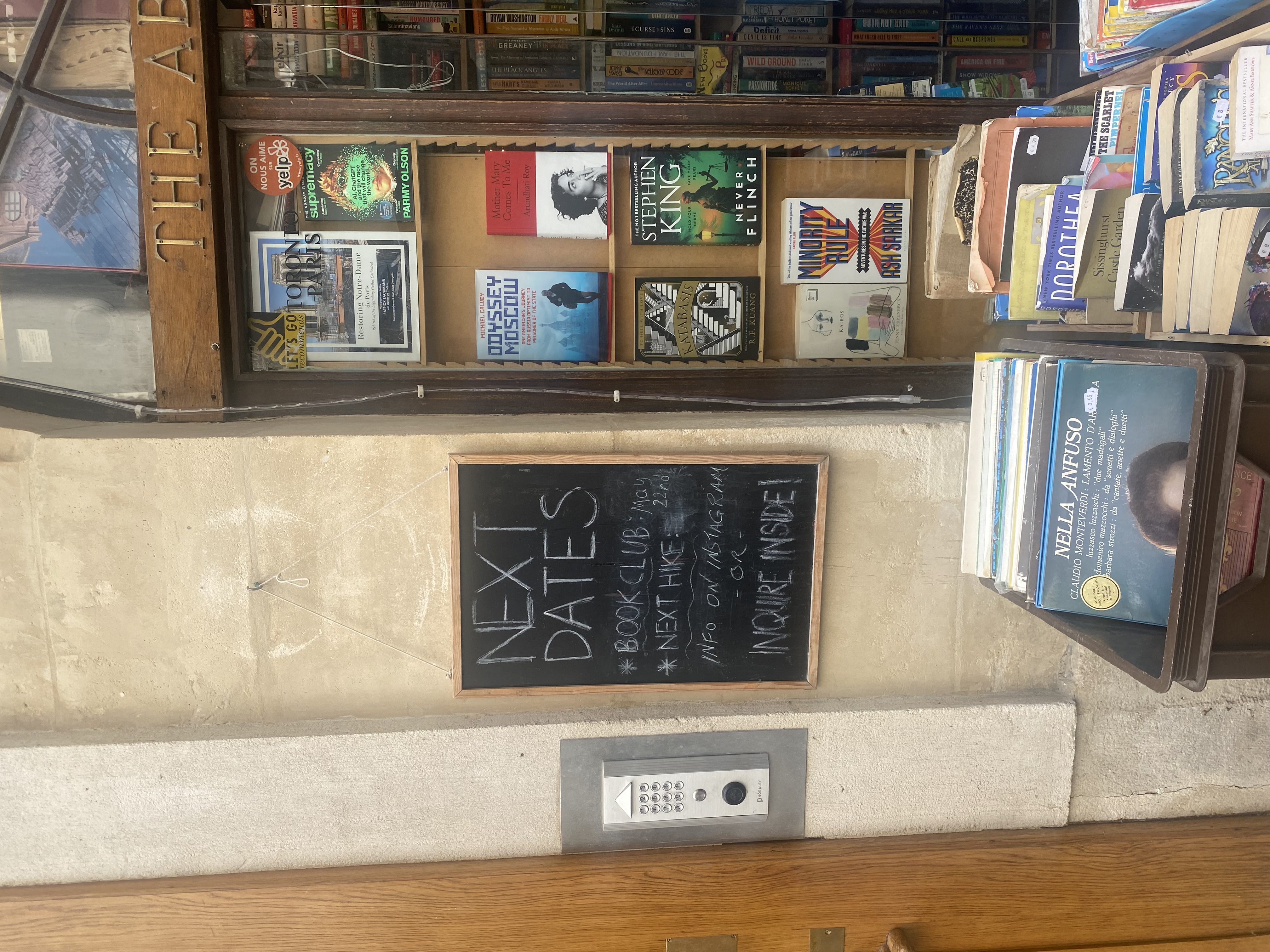
The chalkboard outside. "Inquire inside" — as if the real things can't be announced on the street.
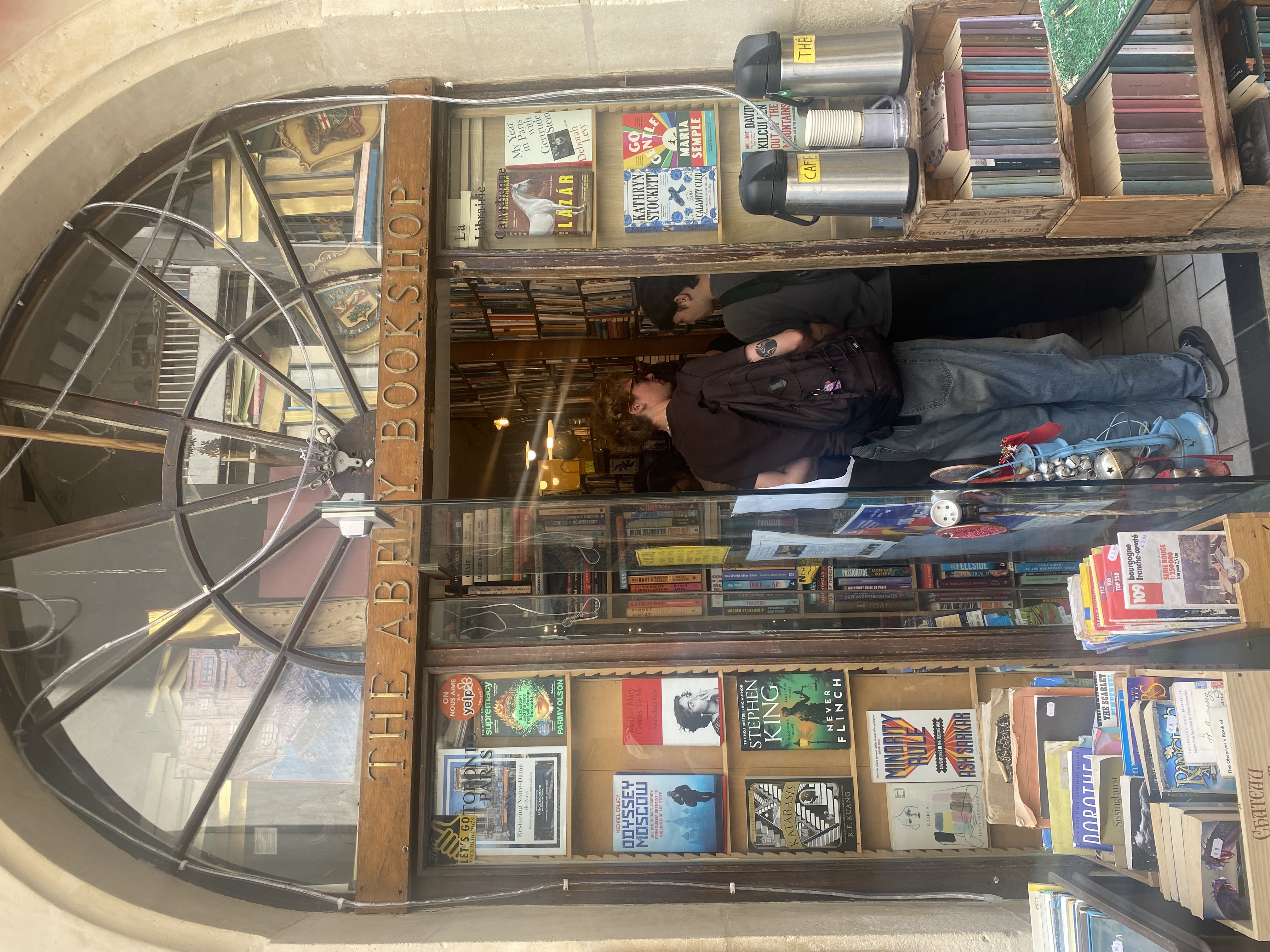
The Abbey is a Canadian bookshop in Paris, which sounds like a contradiction but isn't. It was founded in 1989 by Brian Spence, a man from Ontario who came to Paris and apparently decided that what the 5th arrondissement needed was more English literature and free coffee. He was right. The coffee is still there — thermoses sitting on a wooden crate by the door, paper cups beside them, free to whoever walks in. This detail alone tells you everything about the philosophy of the place.
The entrance. The arch. The warm glow inside that you can see from the street.
The inside is what I imagine a scholar's fever dream looks like. Books are stacked in every available direction — on shelves that reach the ceiling, in piles on the floor, in the windows, in the spaces between windows. There's a "Linguistics" sign above a shelf so crammed with titles that the sign itself seems to be holding them in place. A "Fiction" arrow points deeper into the rabbit hole, past people browsing with the focused calm of people who are not in a hurry, who never were in a hurry, who perhaps decided some years ago that hurrying was not particularly useful.
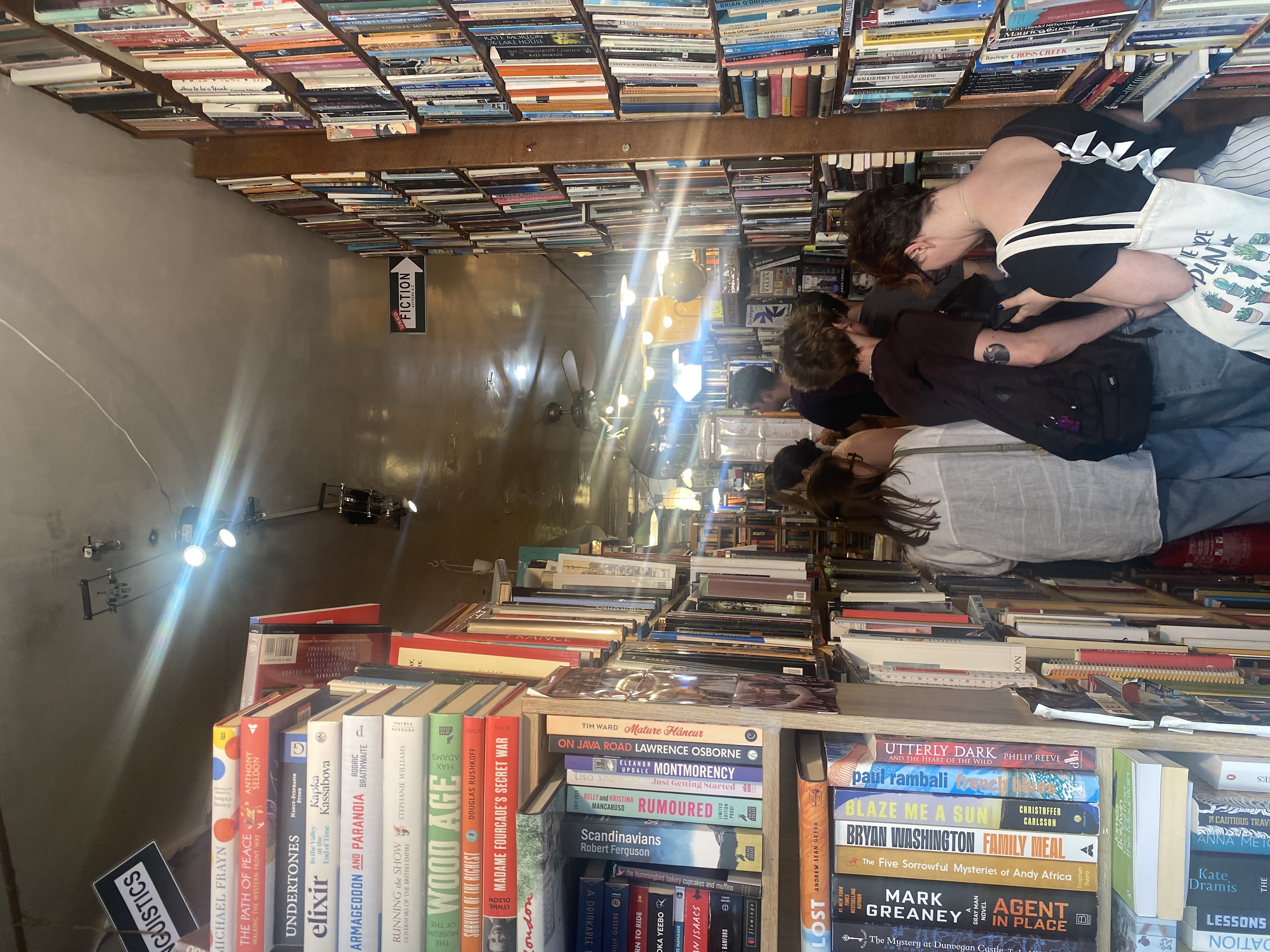
The inside. Books to the ceiling. People who came for five minutes and stayed for an hour.
I stood in one of the narrow corridors between shelves for a long time. Not reading — just looking. It felt like stepping into someone's private library — the library of a person who had been collecting for fifty years and had never once thrown anything away, because every single book seemed like it might matter to someone, someday. I left with two books I hadn't heard of before I walked in. That seems right.
Le Tiers Mythe
2 Rue Flatters, 5th arrondissementThe name itself is an invitation to pause. Le Tiers Mythe — the third myth, or the partial myth — feels like a phrase from a book you'd find inside, underlined in pencil by a previous owner. The façade is the colour of a theatre curtain: deep, confident crimson with gold lettering. It announces itself on its Haussmann street corner without apology.
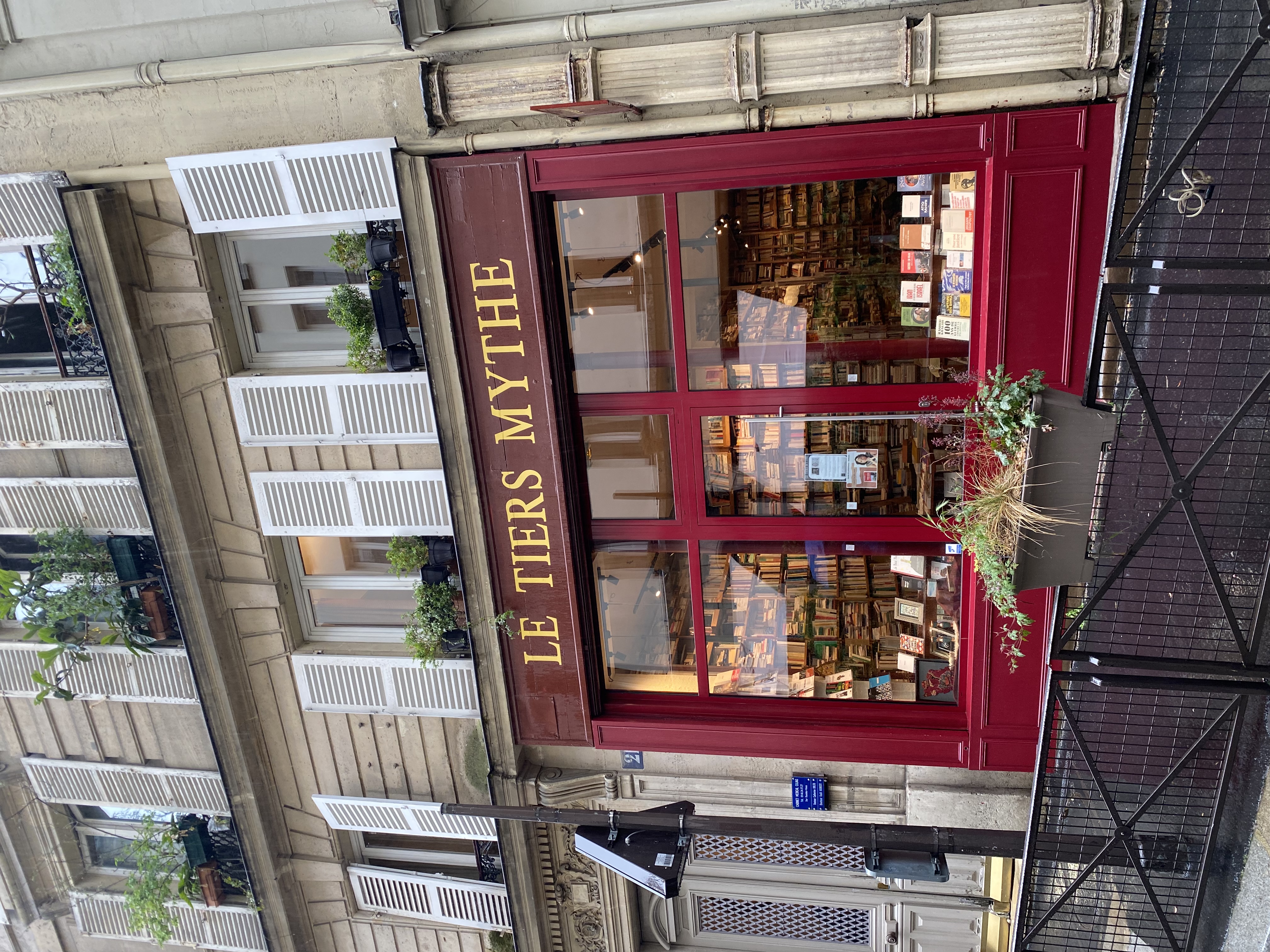
Le Tiers Mythe. The kind of façade that makes you slow down even if you weren't planning to stop.
This is a secondhand bookshop in the truest sense — the French sense, which carries no implication of lesser. The books here are mostly French, mostly non-fiction, and arranged with a logic that is entirely internal. You will not find clear alphabetical order. You will find a wooden ladder leaning against a wall of floor-to-ceiling shelves, and you will feel, as you look up at it, that whoever climbs that ladder knows exactly what they're looking for at the top.
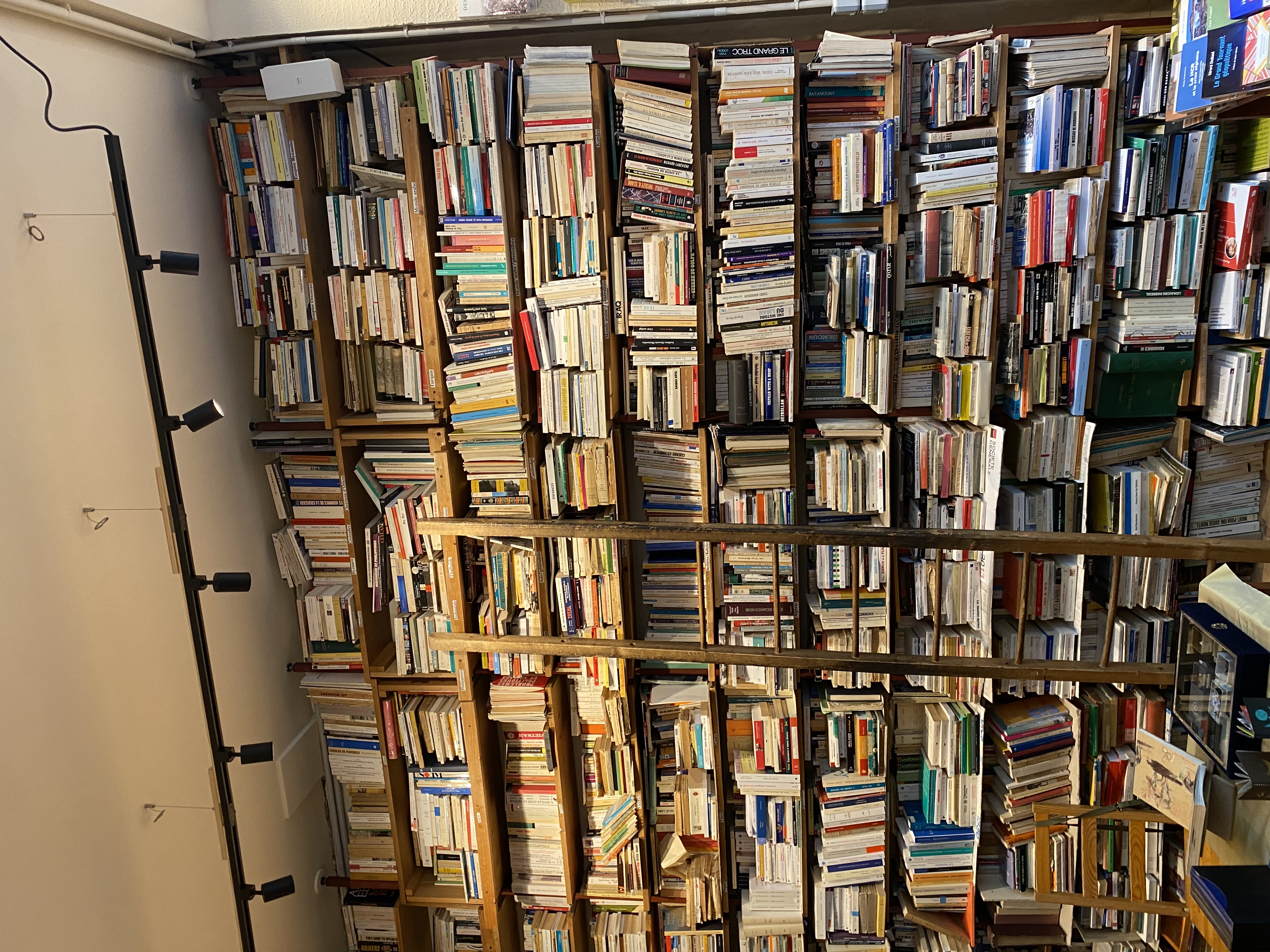
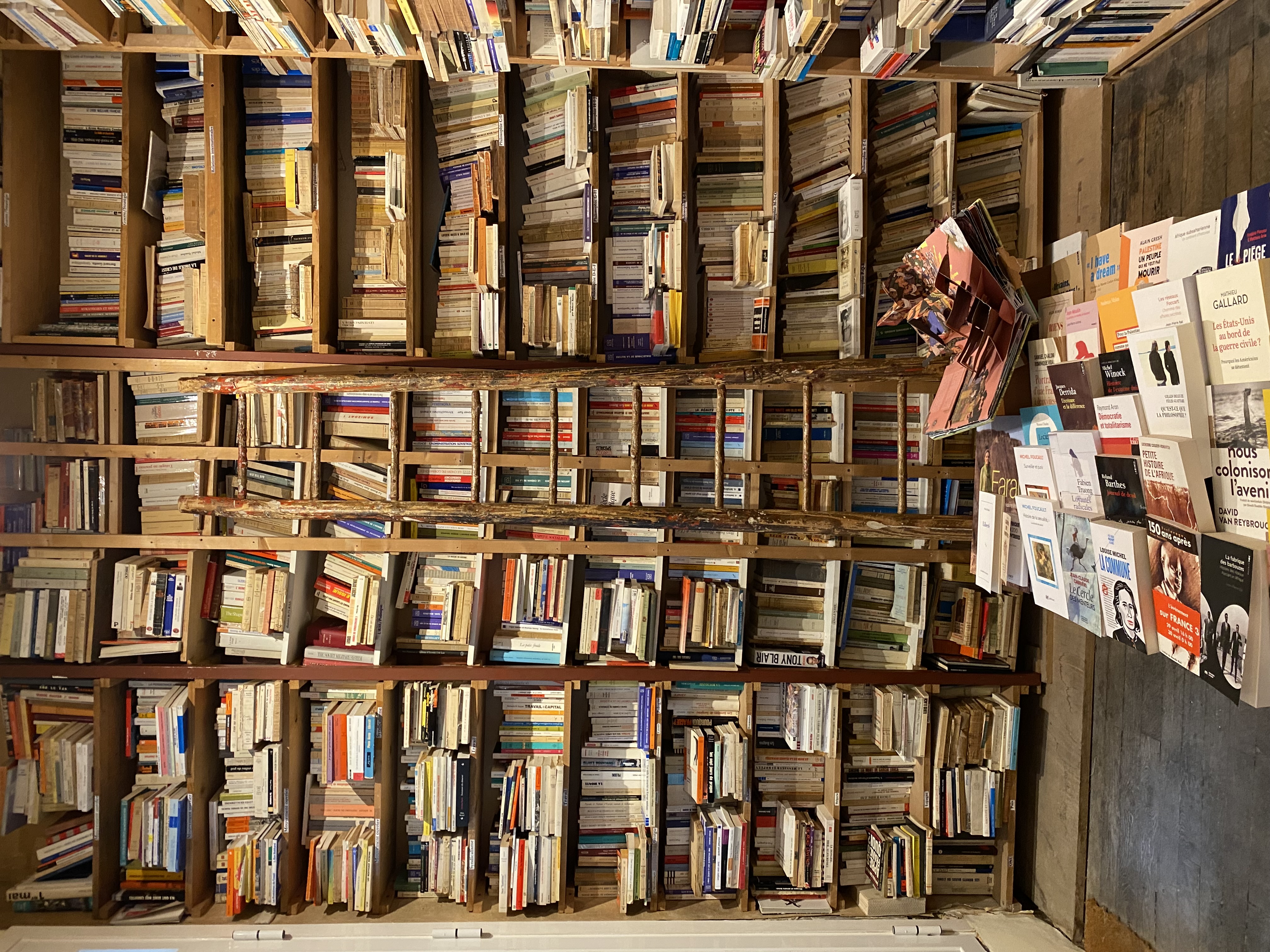
The ladder is not decorative. It is necessary.
What I noticed was the density. Not the chaos — there's a difference. Chaos implies disorder that nobody intended. The Tiers Mythe has the ordered density of a place where someone has thought carefully about how many books can occupy a given wall without the wall complaining. The answer, it turns out, is: many more than you'd expect. Books are stacked horizontally on top of shelves that are already full vertically. Books lean against other books. There are books on the floor arranged around the base of the ladder in a pattern that suggests rotation rather than abandonment.
I asked about a title. The person behind the counter located it without moving more than three steps. That level of spatial knowledge — knowing where a specific book lives in a room that looks like it was packed by instinct — is its own kind of expertise. Paris has made a culture of honouring it.
Merci — La Librairie
111 Boulevard Beaumarchais, 3rd arrondissementMerci is, technically, a concept store. I mention this only to immediately say that what it has done with its bookshop section makes that fact irrelevant. La Librairie is housed in a long, narrow room off the main store — a room lined floor to ceiling with books on slate-blue shelves, underlit with a thin gold strip of warm light that runs the length of the wall like a sentence that never ends.
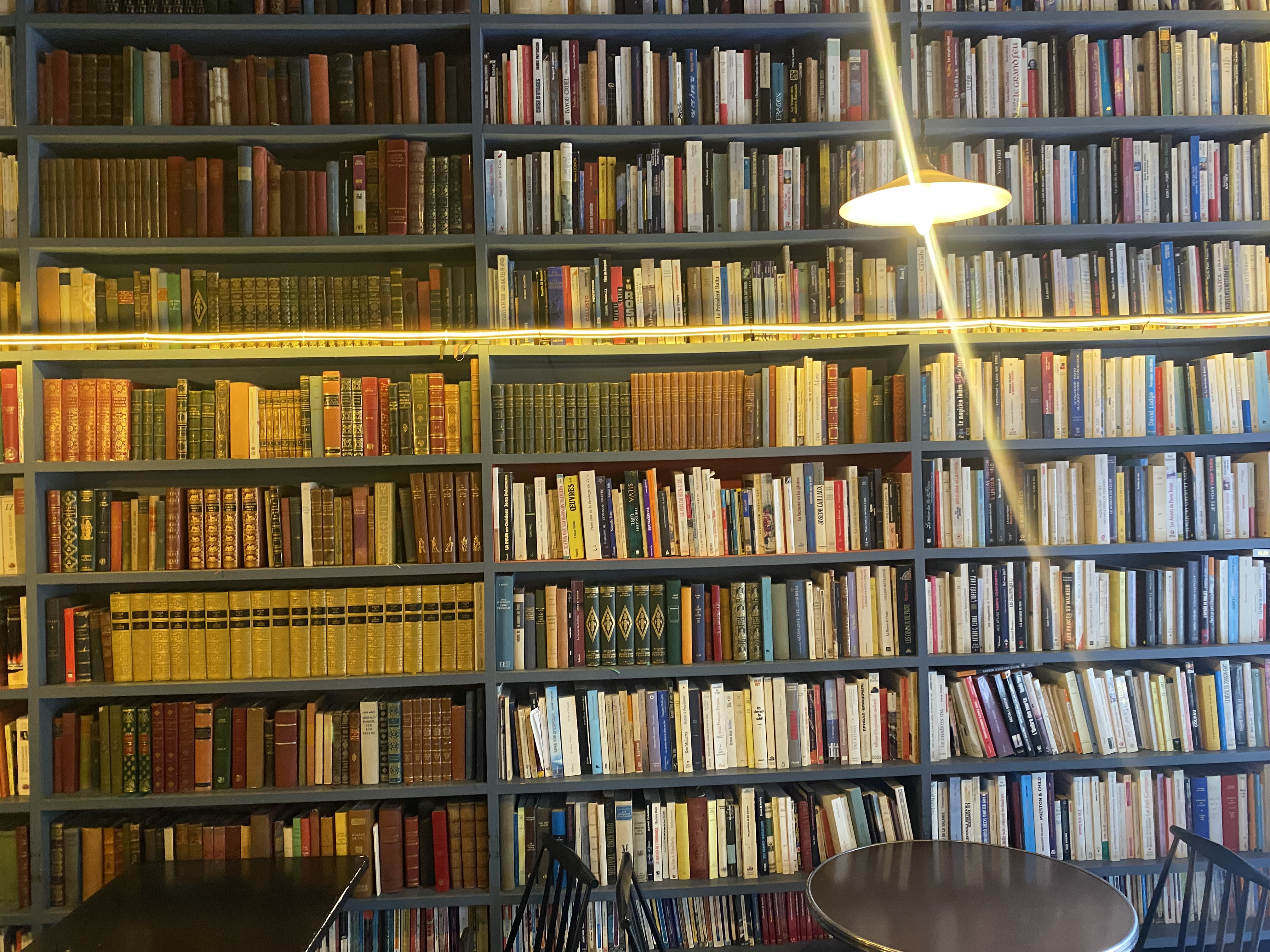
The wall. The light. The particular gold that runs under every shelf like a held breath.
The selection here is curated with the same editorial rigour you'd expect from a space that has always taken aesthetics seriously. These are not books chosen because they sell — they are books chosen because someone at Merci read them and believed they belonged here, in this room, on this shelf, next to these other books. The curation has a point of view. That point of view leans literary, quietly political, deeply French without being provincial.
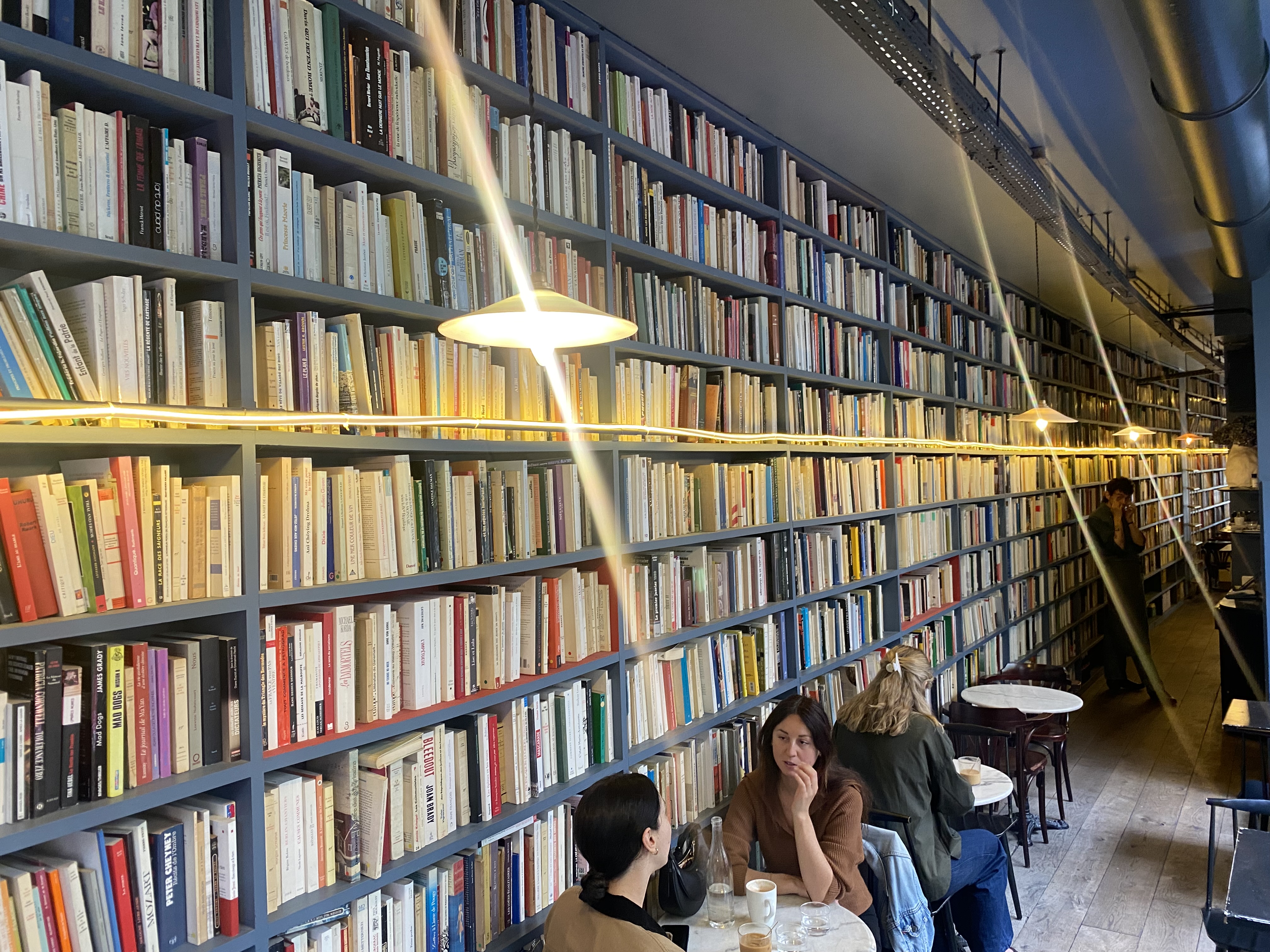
The room runs the length of a thought. People sit at the marble tables and don't leave.
What makes it work is the furniture. Bistro chairs, marble-topped tables running along the opposite wall from the shelves. You can sit. You can order a coffee from the small bar at the back. You can open a book and read the first chapter before deciding whether to buy it. This is either a very French attitude toward commerce or a very humane one. I think it is both.
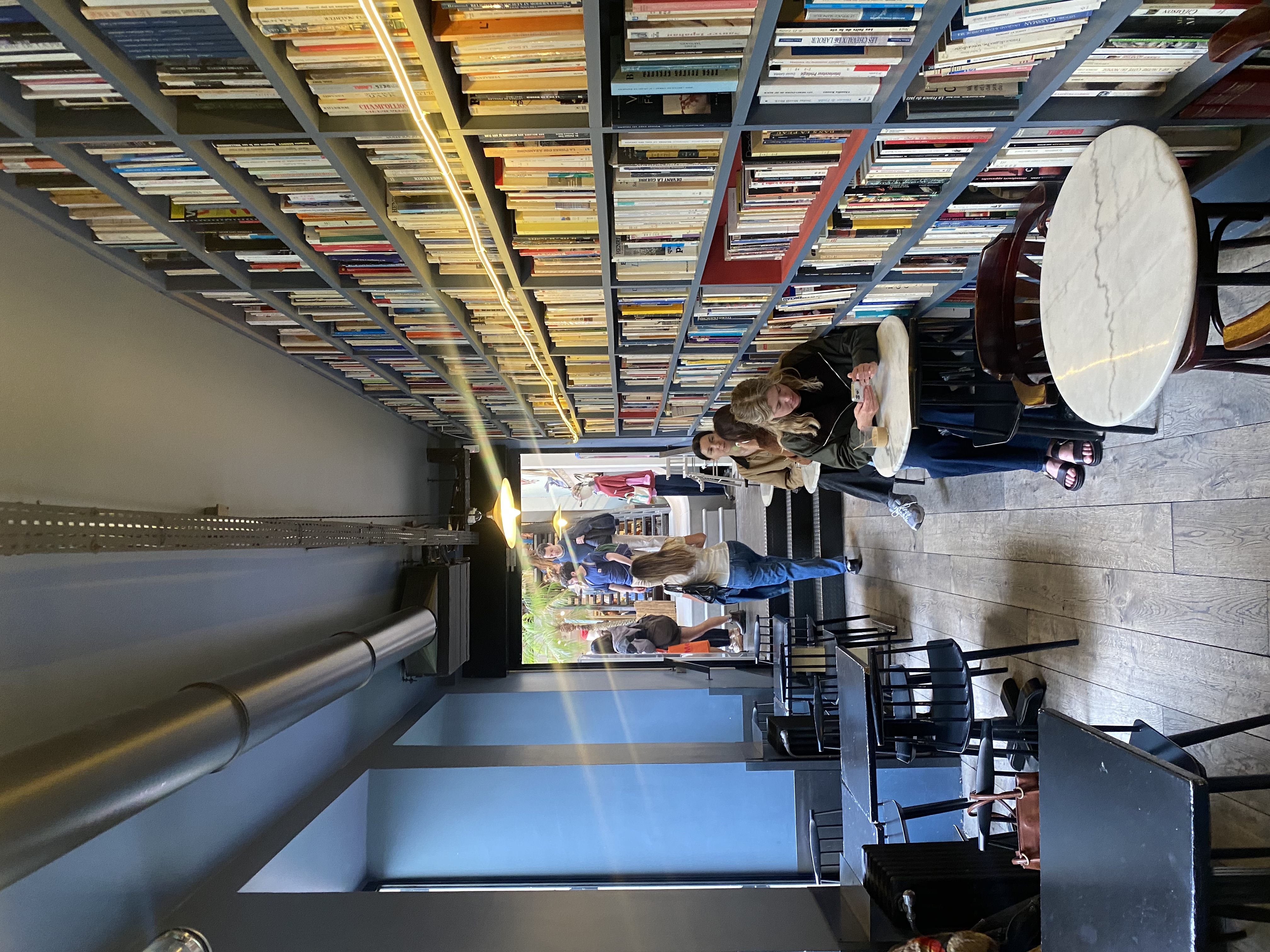
Two people at a table. The shelves behind them. Books and coffee and conversation — the original trio.
I sat for longer than I planned. The woman across the room from me was deep in something, her coffee untouched and cool. Nobody rushed her. Nobody was going to. This, I kept thinking, is what a bookshop is for: not just the transaction of buying books, but the slower transaction of being near them — of letting them sit at the edge of your attention while you think about other things, and then reaching for one when you're ready.
Three bookshops. Three different philosophies of what a bookshop is for. The Abbey believes in accumulation and welcome — every book kept, coffee always free, come in and stay. Le Tiers Mythe believes in depth — in the specialist knowledge that lets a room of apparent chaos become, for the right person, entirely navigable. Merci believes in the beautiful life — that a bookshop should be a room you want to inhabit, not just pass through.
What they share is the thing that Paris seems to understand better than most cities: a bookshop is a place that takes your time seriously by refusing to rush you through it. The French have a phrase — prendre le temps — which translates roughly as "to take the time," but carries with it an implication of deliberateness, of choosing not to be in a hurry. These three shops practice it without thinking about it. It has become the way they breathe.
I left Paris with six books, a slightly heavier bag, and the specific feeling of someone who has spent their days well. It's a feeling I associate, more than anywhere else, with going into bookshops and not coming out for a while.
All three shops are within the 3rd and 5th arrondissements. The Abbey Bookshop is cash-friendly and carries a strong English-language selection. Le Tiers Mythe is predominantly French. Merci's bookshop has no separate entrance — walk through the main store and follow the light.